
Easytrak USBL Systems
Easytrak USBL Systems
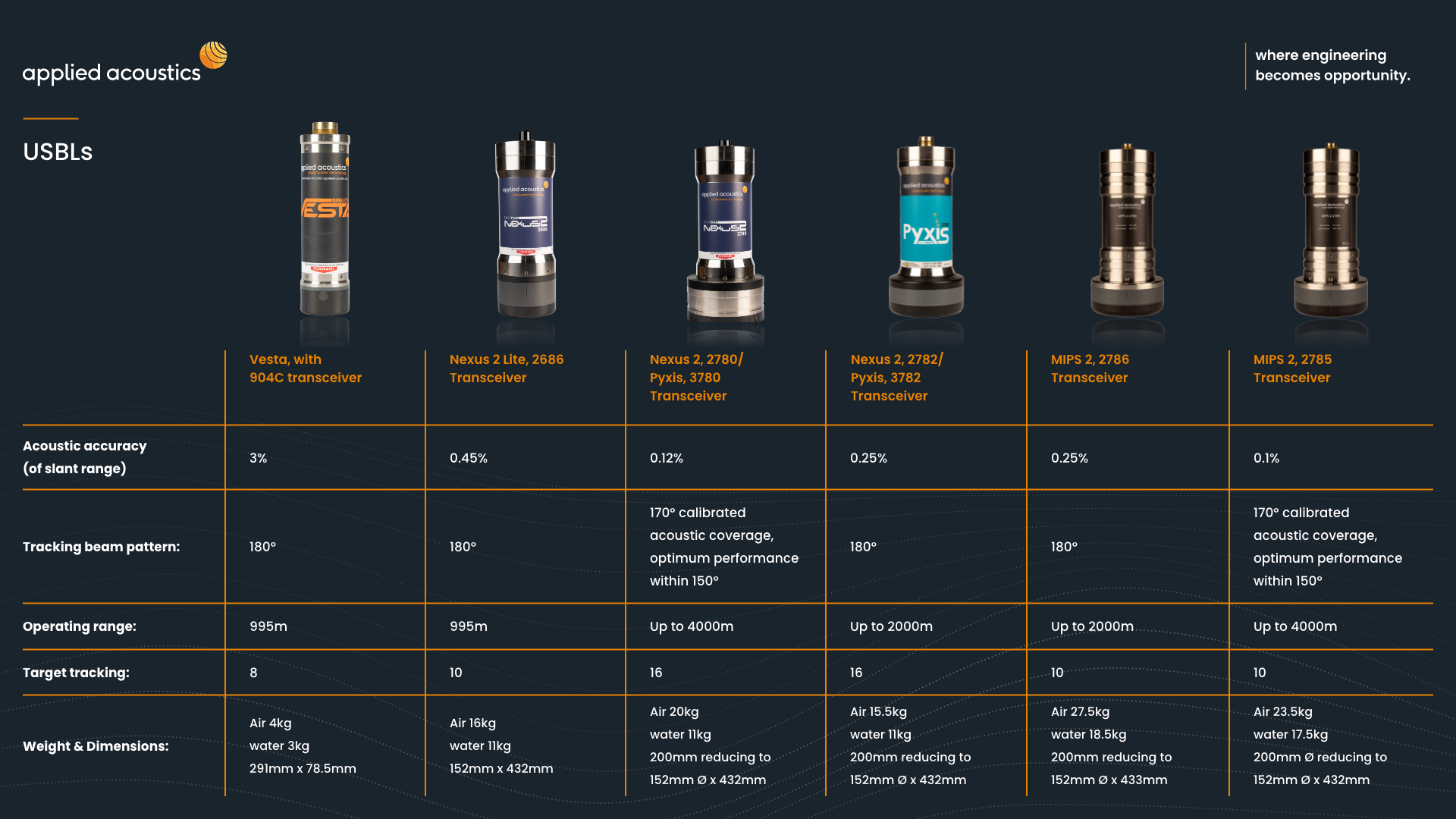
Applied Acoustics USBL positioning systems locate underwater targets by measuring the range and direction of acoustic beacons. Installed on a survey vessel or suitable surface platform, an Easytrak transceiver communicates with beacons carried by ROVs, towfish, divers or subsea equipment. Navigation and heading inputs allow acoustic observations to be related to the project coordinate system.
Vesta: compact positioning
Easytrak Vesta is a compact option for small-vehicle tracking, nearshore survey and inspection. The 904C transceiver configuration is listed with eight targets, 180° acoustic coverage and a maximum range of 995 m. Its listed accuracy is 3% of slant range. A transceiver weighing approximately 4 kg in air supports straightforward mobilisation where deck space and handling arrangements are limited.
Nexus 2 Lite: survey flexibility
Nexus 2 Lite with the 2686 transceiver supports ten targets, 180° coverage and a maximum range of 995 m. Listed accuracy is 0.45% of slant range. This configuration provides a step up for survey teams requiring more targets and higher positioning performance while retaining a compact system layout.
Nexus 2 and Pyxis: longer range and precision
The Easytrak Nexus 2 and Pyxis INS + USBL families offer transceiver choices for different coverage and range requirements. Nexus 2 2780 and Pyxis 3780 configurations are listed with accuracy of 0.12% of slant range and ranges up to 4,000 m. Their calibrated coverage is 170°, with optimum performance within 150°. Nexus 2 2782 and Pyxis 3782 configurations provide 180° coverage, accuracy of 0.25% of slant range and ranges up to 2,000 m. These configurations support up to 16 targets.
Pyxis combines USBL positioning with integrated inertial navigation, supporting a coordinated navigation and subsea-tracking workflow. Nexus 2 Max provides a further system option for projects requiring modern survey interfaces and multi-target operation; the console and transceiver specification should be agreed for the intended installation.
Selecting a complete system
Start with the required slant range, acoustic coverage, target count and survey accuracy. Allow for vessel noise, mounting geometry, sound velocity, navigation quality and calibration. Maximum range and quoted accuracy are configuration-specific; they are not guaranteed in every acoustic environment. Beacon survival depth is a separate parameter from USBL operating range.
Combine the selected system with compatible acoustic positioning beacons, appropriate deployment hardware and survey software and accessories. This approach helps match the transceiver, target units, interfaces and operational workflow to the project.