
Easytrak Nexus 2 USBL
Applied Acoustics Easytrak Nexus 2
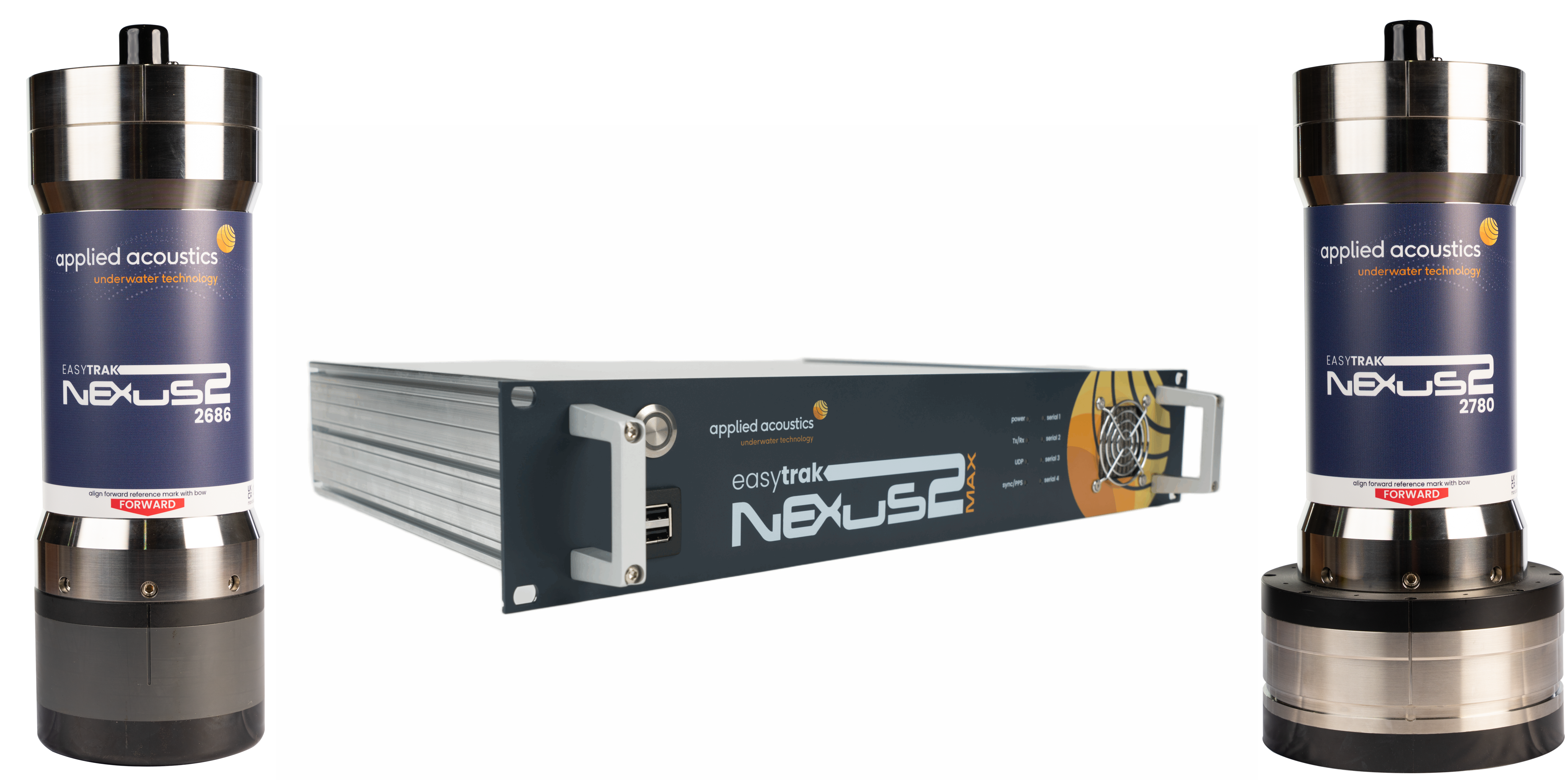
Easytrak Nexus 2 is an Applied Acoustics USBL positioning system for survey, inspection and subsea vehicle tracking. A vessel-mounted transceiver measures the range and direction of compatible acoustic beacons attached to underwater targets. Combined with suitable vessel navigation and heading inputs, these observations provide target positions for the survey team.
Tracking and survey workflow
Nexus 2 uses Sigma 2 spread-spectrum acoustics and supports up to 16 targets. Typical applications include tracking ROVs, towed instruments and other subsea assets during inspection, construction support and hydrographic operations. System selection should account for the working depth, vessel noise, deployment geometry and required acoustic coverage.
Navigation overlays, target logging and replay help operators monitor a survey and review recorded positions. Calibration and the correct measurement of transceiver and navigation-sensor offsets are essential parts of installation. Compatible beacons, cables and software options should be selected as a complete positioning package.
Transceiver options
- Nexus 2 with 2780: listed positioning accuracy of 0.12% of slant range, operating range up to 4,000 m and 170° calibrated coverage, with optimum performance within 150°.
- Nexus 2 with 2782: listed positioning accuracy of 0.25% of slant range, operating range up to 2,000 m and 180° acoustic coverage.
These figures describe the respective configurations and are not interchangeable. Achievable performance depends on acoustic conditions, beacon selection, calibration, sound-velocity information and the quality of navigation inputs. Acoustic range is also different from the depth rating of a beacon or transceiver.
Planning an installation
Start with the target type, maximum slant range and number of simultaneous targets. Consider transceiver mounting, deployment and recovery arrangements, cable routing and the interface to the survey software. For projects requiring integrated inertial assistance, compare the Pyxis INS + USBL option. The positioning beacon range provides complementary target units for different operating environments.
Nexus 2 Max and Lite specifications
| Parameter | Nexus 2 Max 2698 | Nexus 2 Lite 2696 |
|---|---|---|
| Simultaneous targets | 16 | 10 |
| Console size | 482 × 88 × 345 mm; 19-inch 2U rack | 252 × 260 × 54 mm desktop |
| Console weight | 6.15 kg | 1 kg |
| Frequency band | 18–32 kHz | 18–32 kHz |
| Transceiver depth rating | 30 m | 30 m |
| Navigation overlays | GeoTIFF and DXF | Optional GeoTIFF and DXF |
| Calibration | Embedded EasyCal 2 / AutoCal | Optional EasyCal 2 |
| Interfaces | Serial, 1 Gbps Ethernet, UDP; four responder outputs | USB to user PC; four RS-232 ports |
Maximum range for Nexus 2 Max depends on the transceiver variant: 2782-N and 2780-N are rated to 995 m, 2782-C to 2,000 m and 2780-C to 4,000 m. The 0.25% and 0.12% figures describe acoustic performance for the respective 2782 and 2780 configurations with suitable external attitude inputs; they are not the same as combined performance using the internal AHRS. Nexus 2 Lite with the 2686N transceiver specifies 995 m range, 180° coverage and 0.45% of slant range with external sensors. Correct sound velocity, installation and signal quality are required.