
Sub-bottom and Seismic Survey
Sub-bottom and Seismic Survey
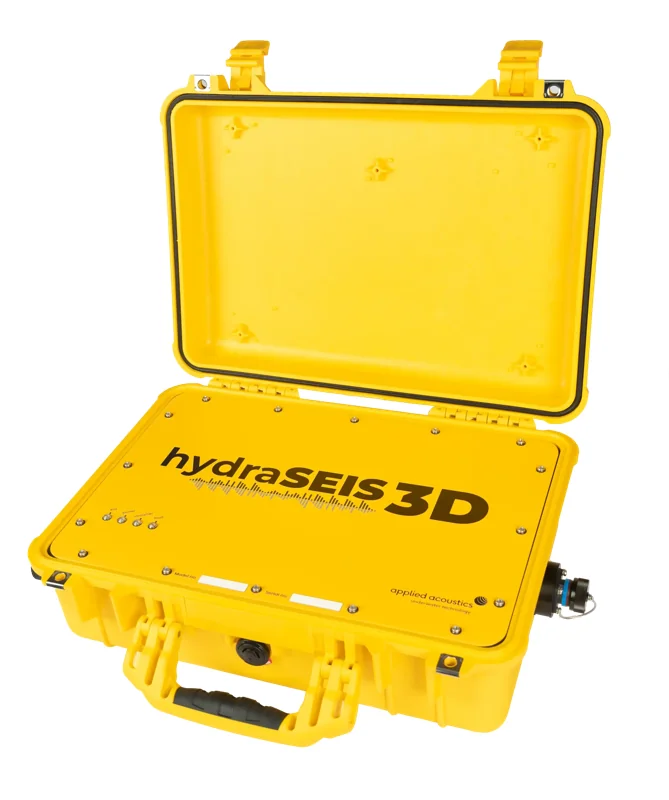
Applied Acoustics provides equipment for sub-bottom profiling and marine seismic surveys, from sound sources and energy supplies to hydrophone streamers and acquisition systems. These systems help survey teams investigate sediment layers and geological boundaries beneath the seabed for offshore site investigations, cable routes and marine engineering projects. The source, receiver arrangement and acquisition configuration are selected together to suit the required detail, target depth and operating conditions.
HydraSeis multi-channel survey systems
HydraSeis brings multi-channel seismic acquisition into an integrated survey arrangement. The supplied system diagram combines an acquisition PC, processing PC and console with a deck unit and a 24-channel streamer section. A navigation PC and MiniPod receiver provide the positioning side of the installation. This coordinated arrangement supports the collection and processing of geophysical measurements alongside the survey geometry.
Dura-Spark sources and boomers
The Dura-Spark range supplies sparker sound sources for high-resolution marine seismic work. The distributor material includes the dual-deck Dura-Spark 400+400, other sparker configurations and deployment photographs. Single-plate boomers and the S-Boom system provide further source options for sub-bottom profiling. Selection should account for local geology, water depth, survey vessel layout and the resolution required from the finished data.
CSP energy supplies
CSP units power compatible acoustic sources. The range includes CSP-Nv, CSP-SNv and CSP-NP equipment. The CSP-SNv is designed for the dual-deck Dura-Spark 400+400 arrangement and provides flip-flop and fire-delay modes. Source and power-supply compatibility must be checked as a complete configuration rather than choosing components only by their nominal energy rating.
Hydrophones, streamers and source positioning
Hydrophone receivers record reflected acoustic energy for the acquisition system. Streamer sections, reels, high-voltage slip rings and deck equipment complete the practical deployment arrangement. MiniPod GNSS can support surface positioning of the seismic source and streamer head or tail, helping relate measurements to the survey route.
Survey configuration
Kordil can help define a suitable combination of sound source, power supply, receiver, acquisition equipment and positioning components. The system layout should also account for vessel space, towing arrangements, synchronisation and the planned processing workflow. Penetration and data quality depend on geology and operating conditions, so they are assessed for the intended project.
Applied Acoustics geophysical product information
HydraSeis technical specifications
| Parameter | Specification |
|---|---|
| Channels per section | 12 or 24 |
| Sampling / conversion | 16 or 8 kHz; 24-bit ADC |
| System channel capacity | 96 at 16 kHz; 192 at 8 kHz |
| Group interval | 1 or 2 m |
| Active section length / nominal diameter | 24 m / 45 mm |
| Streamer depth rating | 30 m |
| Data interface / acquisition format | 100 Mbps Ethernet / SEG-D |
| Power | 115/230 V AC console; 48 V DC streamer |
Source specifications
| Parameter | Dura-Spark UHD | S-Boom |
|---|---|---|
| Source arrangement | 240 or 400 tips | Three AA252 boomer plates |
| Typical energy per shot | 1,000 J (240); 2,000 J (400) | 700–1,000 J |
| Maximum energy per shot | 1,250 J (240); 2,400 J (400) | 1,000 J |
| Typical bandwidth / pulse | 300 Hz–1.2 kHz / 0.5–1.5 ms | 300–500 microsecond pulse |
| Supply voltage | 3,000–4,000 V | 3,600–4,000 V DC |
HydraSeis acquisition records navigation with seismic data and provides live quality checks during collection. Source energy, shot interval and tow geometry should be chosen as a coordinated configuration. S-Boom also supports freshwater and low-salinity work; actual penetration and resolution depend on seabed conditions and acquisition settings.
Technical datasheets
- HydraSeis technical datasheet (PDF)
- Dura-Spark UHD technical datasheet (PDF)
- S-Boom technical datasheet (PDF)
View the Applied Acoustics product range
Contact Kordil for product selection and technical support.