
LCSonar
Shark-S75T Deep-Water Triple-Frequency Side-Scan Sonar
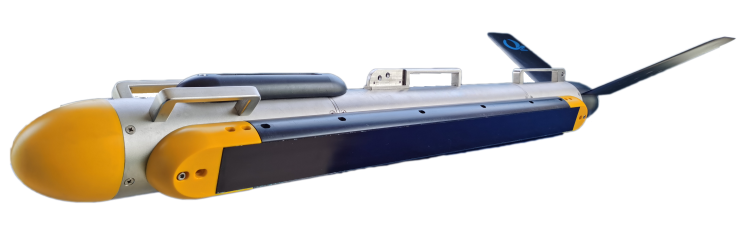
LC Sonar Shark-S75T is a deep-water triple-frequency side-scan sonar designed for wide-area seabed mapping and high-resolution underwater target detection. Its 75, 225 and 750 kHz operating frequencies allow surveyors to select the most suitable frequency combination for long-range coverage, general seabed imaging or detailed target investigation.
The system supports 75/225 kHz and 225/750 kHz dual-frequency combinations with LFM CHIRP and continuous-wave transmission modes. The 75 kHz channel provides a maximum operating range of up to 600 m, while the 750 kHz channel delivers detailed imagery with a horizontal beamwidth down to 0.2° and across-track resolution down to 1.25 cm.
The Shark-S75T is suitable for deep-water geophysical surveys, cable and pipeline route investigations, wreck and debris searches, marine archaeology, offshore renewable-energy projects, maritime-channel surveys and mine-countermeasure applications.
Deep-Water Towfish System
The Shark-S75T towfish is manufactured from corrosion-resistant 316L stainless steel and rated for operation to a depth of 2,000 m. A customized version rated to 6,000 m is available for ultra-deep-water applications.
The standard towfish incorporates a single-beam echosounder for bottom tracking, an attitude sensor for pitch, roll and heading, and a pressure sensor for towfish depth. Its underwater overload-protection design helps protect the towfish against impacts and excessive loads during deployment and recovery.
The system supports several installation and deployment methods, including conventional towing, hull mounting and side mounting. Optional provisions are available for magnetometer interfacing and underwater positioning equipment.
Features and Benefits
- Triple-frequency capability at 75, 225 and 750 kHz
- Selectable 75/225 kHz and 225/750 kHz operating combinations
- Long-range seabed imaging and high-resolution target detection
- LFM CHIRP and continuous-wave transmission modes
- Maximum range of up to 600 m at 75 kHz
- Horizontal beamwidth down to 0.2° at 750 kHz
- 316L stainless-steel deep-water towfish
- Standard depth rating of 2,000 m
- Customizable depth rating up to 6,000 m
- Integrated single-beam echosounder for bottom tracking
- Integrated pitch, roll, heading and pressure sensors
- Real-time sonar mosaicking and online mapping
- OTSS and standard XTF data recording
- Continuous raw-data output and SDK support
- Optional magnetometer and underwater-positioning integration
- Towed, hull-mounted and side-mounted deployment options
Triple-Frequency Operation
The three operating frequencies allow the Shark-S75T to balance survey range and image resolution according to the application.
- 75 kHz: Long-range and wide-area seabed coverage
- 225 kHz: Balanced survey range and target resolution
- 750 kHz: Ultra-high-resolution imaging and detailed target inspection
Low-frequency operation is suitable for efficient reconnaissance and large-area surveys. Higher-frequency operation provides sharper target definition for wrecks, pipelines, cables, debris, seabed objects and other features requiring detailed inspection.
Actual operating range and image quality depend on towfish altitude, water conditions, acoustic noise, seabed characteristics and the selected transmission parameters.
OTech Sonar Software
The Shark-S75T is supplied with LC Sonar’s proprietary OTech software for survey planning, sonar control, real-time visualization, data recording and target management.
Software functions include:
- Real-time side-scan waterfall display
- Real-time sonar-image mosaicking
- Live online mapping
- Survey-line planning and navigation
- Vessel and towfish track display
- Survey-coverage visualization
- Data recording and playback
- Target marking, management and export
- Multi-window sensor-data display
- Adaptive image equalization
- Near-range and far-range image balancing
- OTSS and standard XTF recording
- Continuous raw-data output
- Software development kit support
The software uses adaptive equalization processing to maintain consistent image quality across near and far ranges. Standard XTF output allows recorded data to be processed using compatible third-party side-scan sonar applications.
SDK and continuous raw-data options support specialized integration, customized workflows and the future development of AI-assisted automatic target-recognition applications.
Typical Applications
- Deep-water seabed mapping
- Marine geological and geophysical surveys
- Cable and pipeline route surveys
- Cable and pipeline inspection and maintenance
- Wreck and sunken-container searches
- Marine debris and underwater-hazard detection
- Maritime-channel and harbour surveys
- Underwater archaeological investigations
- Offshore wind-farm site surveys
- Renewable-energy seabed investigations
- Mine-countermeasure surveys
- Underwater target detection and classification
- Search and recovery operations
- Deep-sea scientific research
Sonar Specifications
- Model: Shark-S75T
- Operating frequencies: 75, 225 and 750 kHz
- Frequency combinations: 75/225 kHz and 225/750 kHz
- Pulse types: LFM CHIRP and CW
- Vertical beamwidth: 50°
- Transducer mounting angles: 10°, 15° or 20° downward
- Standard factory mounting angle: 20°
Range and Beamwidth
- Maximum range at 75 kHz: 600 m
- Maximum range at 225 kHz: 300 m
- Maximum range at 750 kHz: 90 m
- Horizontal beamwidth at 75 kHz: 1°
- Horizontal beamwidth at 225 kHz: 0.3°
- Horizontal beamwidth at 750 kHz: 0.2°
Maximum ranges are dependent on environmental conditions, system configuration, towfish altitude and seabed reflectivity.
Resolution
- Across-track resolution at 75 kHz: 5 cm
- Across-track resolution at 225 kHz: 2.5 cm
- Across-track resolution at 750 kHz: 1.25 cm
- Published along-track resolution at 75 kHz: 0.18h
- Published along-track resolution at 225 kHz: 0.005h
- Published along-track resolution at 750 kHz: 0.003h
Integrated Sensors
- Single-beam echosounder for bottom tracking
- Pitch sensor
- Roll sensor
- Heading sensor
- Pressure and depth sensor
Towfish Specifications
- Construction material: 316L stainless steel
- Maximum standard operating depth: 2,000 m
- Optional customized depth rating: Up to 6,000 m
- Length: 1,464 mm
- Diameter: 105 mm
- Weight in air: 45 kg
- Optional magnetometer interface
- Optional underwater-positioning mounting structure
- Underwater overload and impact protection
Deck Unit Specifications
- Length: 248 mm
- Width: 192 mm
- Height: 70 mm
- Weight: 1.9 kg
- Power supply: 110/220 VAC
- Power consumption: 60 W
Tow Cable and Deployment
The standard system is supplied with a 100 m high-strength armoured coaxial tow cable. Alternative cable lengths can be configured according to operational requirements, and an optional winch is available for deep-water deployment.
Supported deployment methods include:
- Conventional towfish operation
- Hull mounting
- Side mounting
- Integration with underwater positioning systems
- Combined operation with an optional marine magnetometer
Data and Integration
- Proprietary OTSS data recording
- Standard XTF data output
- Continuous raw-data output
- Real-time mosaicking
- Live survey mapping
- Target management and export
- SDK support for customized applications
- Third-party post-processing compatibility
- Support for AI-assisted target-recognition development
LC Sonar Shark-S75T is available through Kordil. Contact us for quotations, system configuration, cable and winch options, underwater-positioning integration, magnetometer integration and technical support.